
Dartmouth has long served as an important backdrop for an exciting subfield at the crossroads between quantum physics and gravitational physics. Many physicists believe that the gravitational field itself should ultimately be quantized – much in the same way the electromagnetic field is. Towards this goal, however, many preliminary questions remain on understanding how gravity works in a regime where it can still be treated as classical, yet couples to microscopic states of matter for which a quantum description is a must.
Three Dartmouth physics professors have proposed a new experiment that would precisely test just that. Professors Roberto Onofrio, Alexander Smith, and Lorenza Viola published 'Testing the weak equivalence principle for nonclassical matter with torsion' in the December issue of Physical Review D. Their work builds on decades of discovery and collaboration that has many ties back to Dartmouth.
Back in 1975, Dartmouth alumnus Samuel Werner '59 and his colleagues were the first to probe the effects of gravity on a quantum system, in what was dubbed the COW experiment after the initials of the experimentors. Using a device called interferometer, they sent a beam of neutrons along two paths simultaneously, one higher than the other, creating what is known as a quantum superposition. Because of the height difference in Earth's gravitational field, the two quantum waves for each path interfered with each other, much like ripples on a pond. The resulting pattern served as a historic first test of how quantum objects should behave and "free-fall" in the gravitational field, and provided the first evidence of the validity of the weak equivalence principle (WEP) in the quantum realm.
The WEP states that inertial mass and gravitational mass are exactly proportional to each other, in such a way that the trajectory of any particle in free fall is independent of its internal structure and composition. Classic laboratory tests, most famously the torsion‑balance experiments of the early 20th century, have confirmed the WEP to incredible precision and have resulted in increasingly stringent bounds to any violation. Since the 80's, interferometry of massive particles has also been used to test the WEP in the quantum realm – first using neutrons in the pioneering experiments of Werner and collaborators, and then using atoms, which have the advantage of a rich and diverse internal structure.
In 1997, Viola and Onofrio suggested to examine falling superpositions of atoms prepared in a superposition state in space, the atoms being here and there at the same time, a so-called Schroedinger cat state. This doesn't account, however, for the possibility that the atom also has internal structure, and can exist in a superposition of different energy states. If the energy, E, of Einstein's famous E = mc2 exists as different values at once, then the inertial mass, m, would be too. "The big question is whether these quantum superpositions still fall in the same way as classical masses do," says Smith. "It would be surprising if this were not the case and would force us to rethink our geometric understanding of gravity and common approaches to quantum gravity."
In their recent Physical Review D article, Onofrio, Smith, and Viola propose an experiment to answer the above question by probing violations of the WEP beyond what was considered before.
Onofrio started brainstorming possibilities with Smith and Viola five years ago. Onofrio has expertise in experimental gravitation and measurements of small forces. Smith, splitting his time between Saint Anselm College and Dartmouth, focuses on phenomena at the intersection of quantum theory and gravitational physics, and has worked on optical variants of the COW experiment. Viola, having worked on relativistic quantum mechanics as a PhD student, is a world leader in controlling quantum systems and suppressing the decay of quantum superpositions into classical states.
The team's proposal revolves around the idea of a dynamic torsion balance, as depicted in the figure to the
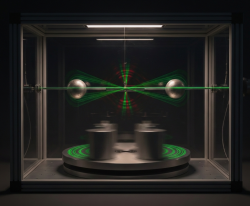
Pictorial view of the dynamical torsion balance experiment proposed by Onofrio, Smith, and Viola. Image created by Alexander Smith with Gemini AI.
right. Imagine a torsion balance whose arms are composed of atoms prepared in a superposition of two different mass states using precisely tuned lasers. Then, a set of heavy masses would spin rapidly around the balance, creating a changing gravitational pull. If the atoms in a mass superposition were to "fall" differently, they would exert a peculiar and variable twisting force, or torque, on the balance. By carefully measuring this torque, physicists could detect even a minuscule violation of the equivalence principle.
"Very recently, there has been a surge in the preparation and control of quantum superpositions in solid-state devices, which led us to believe that a proposal of this type was worth pursuing," says Onofrio.
While challenging, the authors stress that the required technologies are nearly within grasp. Two key advancements are needed, as well as integrated into the same experimental setup: the ability to prepare a large number of atoms in a stable mass superposition, and the ability to build rapidly rotating source masses to create the dynamical gravitational field. Progress on preparing massive nonclassical states is occurring at a fast pace, and rotating masses have already been developed for calibrating gravitational wave detectors.
Their work paves the way for a new generation of experiments at the intersection of quantum mechanics and gravity.
You can read the full publication "Testing the weak equivalence principle for nonclassical matter with torsion," Physical Review D 112, 124015 (2025) by Onofrio, Smith, and Viola here.