
Dartmouth physics professor Rufus Boyack and graduate student Aaron Kleger recently published the paper in condensed matter physics, Physical constraints on effective non-Hermitian systems in the Journal Physical Review B. This work addresses foundational questions on "non-Hermitian" quantum systems, which have gained significant attention in many physics disciplines including condensed matter, atomic, and high-energy physics.
In standard quantum mechanics, physical systems are described by Hermitian operators. Hermiticity is a mathematical property that guarantees foundational physical requirements, including that measurable quantities are real-valued and that probability is conserved during time evolution. In recent years, however, significant interest has emerged in generalized formulations of quantum mechanics that relax this assumption. At the same time, rapid progress in condensed matter physics has led to the widespread use of effective non-Hermitian descriptions, which naturally arise in interacting and dissipative systems, as well as in bosonic settings where the underlying particle statistics can also give rise to an effective non-Hermitian description.
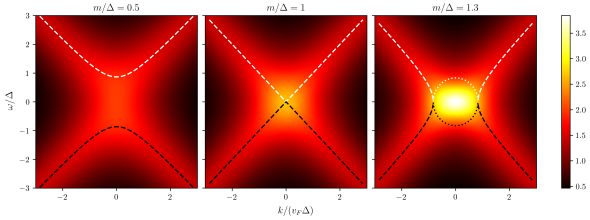
Band structure for various phases of a non-Hermitian Dirac model.
The new work by Kleger and Boyack examines when these effective non-Hermitian descriptions are compatible with the underlying principles of interacting quantum systems. The authors show that a widely used approach to study non-Hermitian physics is generally incompatible with the standard framework of interacting many-body quantum mechanics, violating key consistency conditions tied to causality and the microscopic structure of the theory.
Importantly, Kleger and Boyack show how consistency can sometimes be restored. They demonstrate that certain systems can instead be understood within pseudo-Hermitian quantum mechanics (PHQM), which is a generalized framework in which the Hilbert space is equipped with a nontrivial metric. In this formulation, the Hamiltonian need not be Hermitian in the conventional sense, but instead satisfies a generalized Hermiticity condition relative to the metric. This allows the theory to preserve essential physical properties such as real observables and consistent time evolution.
The authors derive the generalized conditions required for causality within PHQM and identify systems that are naturally described within this framework, challenging how such systems are conventionally interpreted. More broadly, the work helps clarify the necessary conditions for non-Hermitian theories to be physically consistent and advances a deeper understanding of how quantum mechanics itself may be generalized.
You can read Kleger and Boyack's full publication here. You can also review Kleger's google scholar and Boyack's google scholar for their publication lists.